
For many businesses, WiFi is like the electricity supply. You don’t think about it until it stops working properly. That’s where WiFi 7 comes in.
Slow connections, poor Microsoft Teams calls, buffering video, unreliable guest WiFi and frustrated staff can all be symptoms of a wireless network that’s struggling to keep up with the demands of modern business.
That’s why WiFi 7 is generating so much attention.
As the latest generation of wireless technology, WiFi 7 has been designed to deliver faster speeds, improved reliability and a better experience for businesses that rely heavily on cloud services, video conferencing, mobile devices and connected systems.
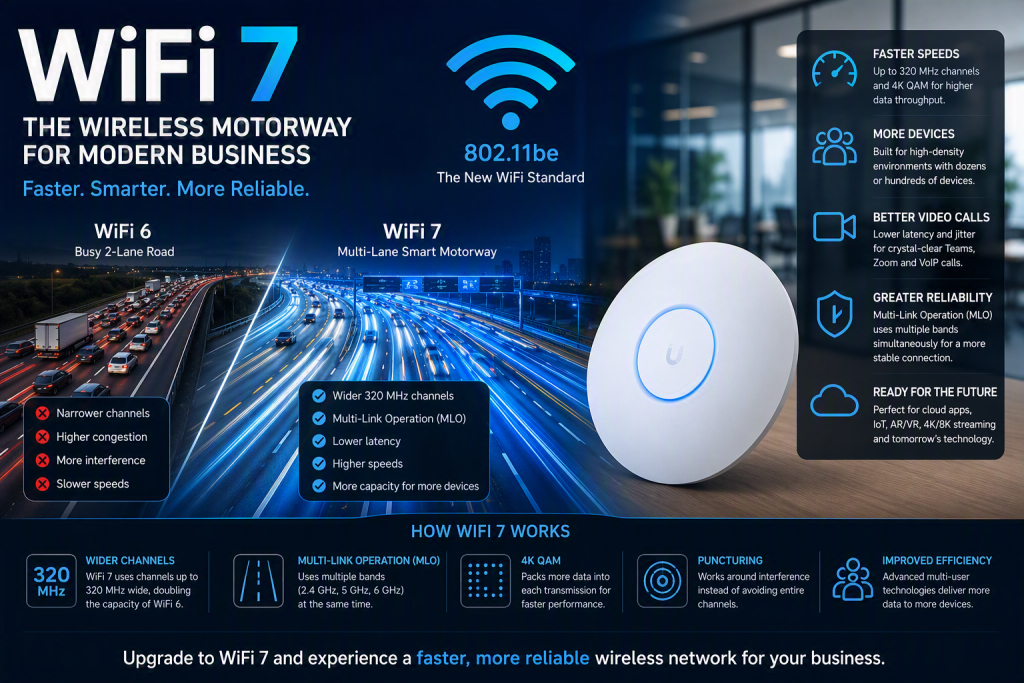
Think of Your WiFi Like a Motorway
Imagine your current WiFi network is a two-lane motorway.
A few years ago, it worked perfectly. There were fewer vehicles on the road, traffic flowed smoothly and everyone reached their destination without delays.
Today, however, that same motorway is much busier.
Every employee has a laptop and smartphone. There are tablets, printers, CCTV cameras, smart TVs, guest devices, cloud applications, Teams calls and countless other systems all trying to use the same network at the same time.
The motorway becomes congested.
Traffic slows down.
Bottlenecks appear.
The occasional traffic jam causes delays for everyone.
WiFi 7 is like replacing that busy two-lane motorway with a modern smart motorway featuring multiple lanes, better traffic management and intelligent routing. More traffic can flow at the same time. Congestion is reduced. Delays become less common. Everyone gets where they need to be much faster.
That’s the difference WiFi 7 can make to your business network.
What Exactly Is WiFi 7?
WiFi 7 is the newest wireless networking standard, known technically as IEEE 802.11be.
Whilst every new generation of WiFi promises faster speeds, WiFi 7 is about far more than simply downloading files faster.
It has been designed to improve performance in busy environments, support more devices simultaneously and provide a smoother experience for modern business applications.
The Geeky Bit
At its core, WiFi 7 increases the amount of data that can be transmitted through the air by using wider radio channels and more efficient encoding methods than previous WiFi generations. Whereas WiFi 6 can use channels up to 160 MHz wide, WiFi 7 can use channels up to 320 MHz wide, effectively doubling the “road width” available for data traffic. It also uses more advanced modulation techniques, allowing each wireless transmission to carry more information in the same amount of spectrum.
One of the most significant technical improvements is a feature called Multi-Link Operation (MLO). Previous WiFi devices typically communicated over one frequency band at a time, such as 5 GHz. WiFi 7 devices can simultaneously use multiple bands, including 2.4 GHz, 5 GHz and 6 GHz, and intelligently switch traffic between them. This increases throughput, reduces latency and provides greater resilience if interference appears on one of the bands. In simple terms, rather than forcing all traffic down a single lane, WiFi 7 can spread traffic across several lanes at the same time.
WiFi 7 also improves efficiency in busy environments. Technologies such as preamble puncturing allow the network to work around interference without abandoning an entire wireless channel, while enhancements to MIMO and multi-user communications help access points serve many devices simultaneously. The result is a network that not only delivers higher peak speeds, but also performs better when dozens or hundreds of devices are connected, making it particularly beneficial for modern offices, cloud applications, video conferencing, CCTV systems and high-density business environments.
/End of gibberish/
Faster Speeds for Modern Businesses
Businesses are transferring larger files than ever before.
Cloud backups, Microsoft 365, online collaboration tools, video content and remote working all place increasing demands on network infrastructure.
WiFi 7 supports significantly higher data rates than previous generations, helping businesses work faster and more efficiently.
For employees, this means less waiting.
For customers, it means a smoother experience.
For business owners, it means improved productivity.
Better Microsoft Teams and Video Calls
How much business is now conducted over video calls? For many organisations, virtual meetings have become a normal part of daily operations.
Unfortunately, poor wireless performance often leads to:
- Frozen video
- Poor audio quality
- Lag and delays
- Dropped connections
- Frustrating meeting experiences
WiFi 7 has been developed with lower latency and improved real-time communication performance in mind, helping applications such as Microsoft Teams and Zoom run more smoothly.
Built for More Devices
Most businesses have far more connected devices today than they did just a few years ago.
Just think about everything currently connected to your network:
- Laptops
- Mobile phones
- Tablets
- Printers
- CCTV systems
- Smart televisions
- Access control systems
- Guest devices
- Internet of Things (IoT) equipment
Every one of these devices competes for network resources.
WiFi 7 has been designed to support high-density environments where dozens or hundreds of devices may be connected simultaneously.
More Reliable Connections
One of the biggest innovations in WiFi 7 is a feature called Multi-Link Operation.
Without getting too technical, this allows compatible devices to communicate using multiple wireless bands simultaneously rather than relying on a single connection path. The result is improved reliability, lower latency and a more consistent user experience.
In business terms, that means fewer complaints from staff and fewer support calls about WiFi problems.
How Do You Know If It’s Time to Upgrade?
Your business may be a good candidate for WiFi 7 if you experience:
- Dead spots around your premises
- Slow wireless speeds
- Unreliable Teams or Zoom calls
- Guest WiFi issues
- Increasing numbers of connected devices
- Performance problems at busy times of day
- An existing wireless system that is more than five years old
Many business owners assume these issues are caused by their broadband connection when, in reality, the wireless network is often the bottleneck.
Future-Proof Your Investment
Technology isn’t slowing down. Businesses continue to adopt more cloud services, more remote working, more AI-powered applications and more connected devices every year. Installing a modern WiFi 7 solution today helps ensure your network is ready for tomorrow’s demands.
Instead of continually dealing with performance issues, your wireless network becomes a platform that supports future growth.
Our Recommendation
We are increasingly recommending modern UniFi WiFi 7 solutions for businesses looking to improve reliability, performance and scalability.
Whether you’re running a small office, a hospitality venue, a retail business or a multi-site organisation, a properly designed WiFi 7 network can transform the way your business operates.
Ready to Leave the Slow Lane?
If your WiFi feels like a congested motorway at rush hour, it may be time for an upgrade.
We can assess your existing network, identify bottlenecks and recommend the most cost-effective route to a faster, more reliable WiFi 7 solution.
Contact us today for a free network review and discover how WiFi 7 can help your business stay ahead.